Foundational Computing Program
The Missing Semester of Modern Technology Education
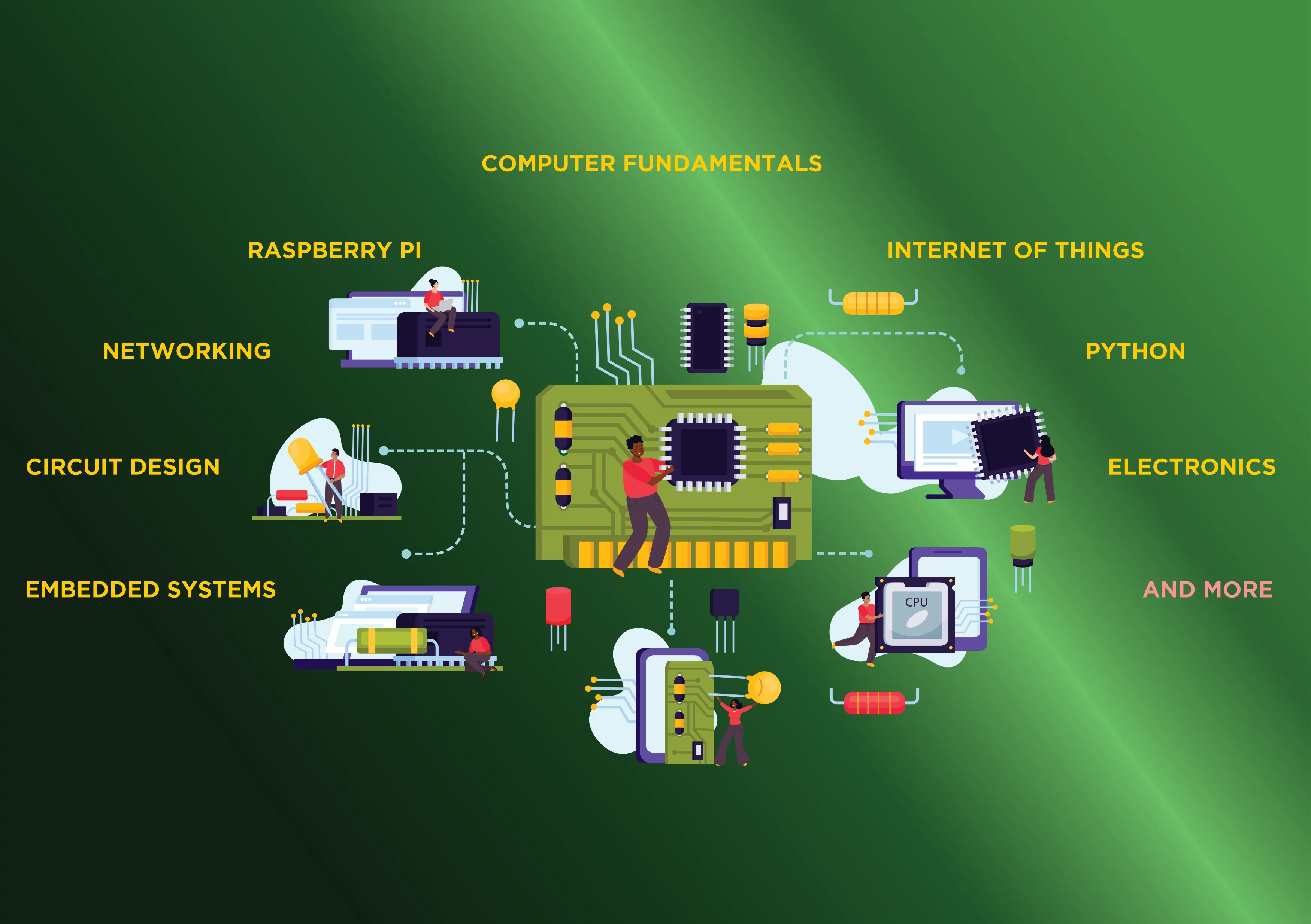
to deeply understand how computers actually work.
Program Details
The Foundational Computing Program (FCP) is a hands-on, mentor-led,designed for students who want to build real computing foundations from the ground up. Most students learn how to use technology, not how it actually works.They write code, use frameworks, and build applications but the computer beneath remains a black box. FCP closes this gap. Students begin with electricity and digital logic, move through computer architecture and operating systems, and apply everything using Raspberry Pi,programming, networking, and system design. This program does not train tool users.It trains students to understand why systems behave the way they do and why they fail.
1. Students aged 18–22 years, any Undergraduate stream
2. No prior coding experience required
3. Willing to allocate at least 3-hour sessions, 2 days a week for the program
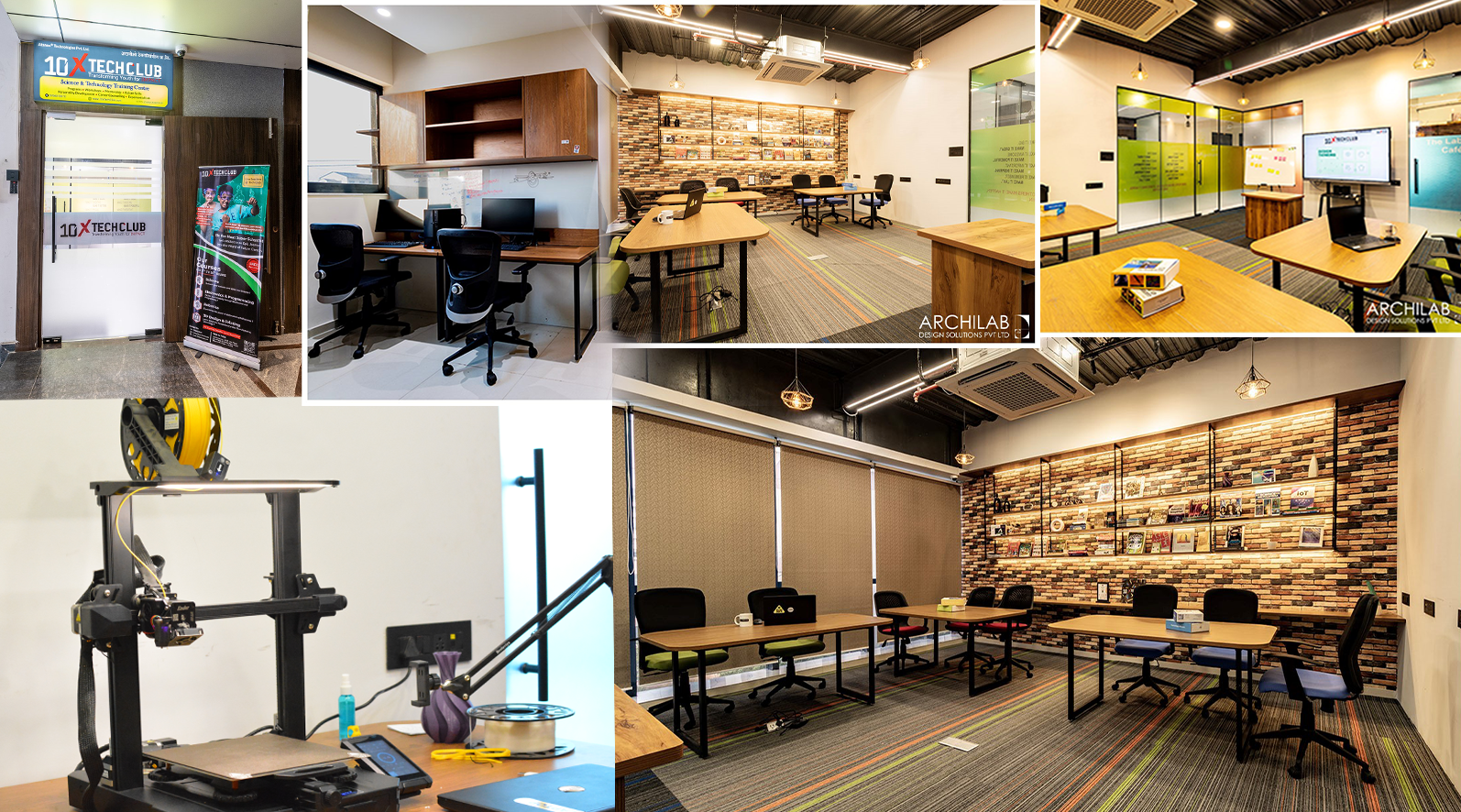
Our Learning Space is welcoming with collaborative classroom, well equipped lab, large digital screen, high speed internet connection and fully airconditioned.
Below are important dates to remember:
Program Dates
Launch from 2 February 2026 – to May 2026.
Class Schedule: Monday & Wednesday | 4:00 PM – 7:00 PM
Exclusive Launch Offer
Programme Fee: INR 60,000
Launch Offer: INR 50,000
Program Duration:
16 weeks (4 months), next batch starts in Feb- 2026
Register Now
The launch fee includes a complete Raspberry Pi hardware kit with all essential components, which students keep and use to build real systems throughout the program. More importantly, the fee covers intensive hands-on labs, structured mentoring, system-level projects, and a capstone that results in a meaningful technical portfolio.
Session Plan
Phase 1: The Physical Foundations of Computing
Electricity fundamentals (current, voltage, resistance), circuit
behaviour, energy flow, and how physical signals become
computation.
Phase 2: Logic, Memory, and Timing
Digital logic (gates, truth tables), combinational circuits,
machine arithmetic, control paths, and mini design challenges
(e.g., ALU thinking).
Phase 3–4: CPU, Memory & Operating Systems
CPU structure, memory hierarchy, instruction execution,
processes, scheduling, and how operating systems manage
resources.
Phase 5: Networking, Connected Systems & IoT
IP addressing, communication models, device-to-device
communication, Raspberry Pi networking, and foundations of
distributed systems.
Capstone: Building a Computing System
Integrate hardware, software, and networking into a complete
working system and present it like a real engineering team—with
clear documentation of design decisions and trade-offs.
Projects
Projects in the Foundational Computing Program (FCP) are not isolated exercises or guided demos. Each project is designed as a system artifact that reinforces how real computing systems are built incrementally,with constraints, trade-offs, and reasoning.
Project Focus Areas:
Physical & Logic Systems
Building and testing circuits, logic blocks, arithmetic units, and
state-based systems to understand how computation emerges from
physical electrical signals.
Control & Execution Systems
Designing timing-driven logic, counters, and control paths that mirror
how real machines coordinate actions and execute instructions
reliably.
Software–Hardware Interaction
Writing programs that directly control hardware behavior, observe
system state, and respond to real-world inputs using Raspberry Pi.
Communication Systems
Implementing device-to-device communication and basic networked
behavior, introducing students to connected and distributed systems.
Documented Engineering Outcomes
Every project produces structured outputs—diagrams, code,
explanations, and observations—so students learn to reason clearly
and defend their design decisions.
Our Mentor
The Foundational Computing Program is led by experienced engineers and mentors who focus on deep understanding, not surface-level tools.Students learn directly from professionals who have built, debugged,and deployed real computing systems across hardware,software, and embedded domains.
Mentors work closely with students through hands-on labs, guided discussions, and one-on-one feedback, helping them reason clearly,ask better questions, and develop confidence rooted in understanding.

Capstone
Capstone: Full System Integration
The program concludes with a full system integration capstone. Students
design, build, and validate a complete computing system on
Raspberry Pi that integrates:
• Hardware inputs and outputs
• Software control and execution
• Operating system behavior
• Networking or connected components
Teams are required to:
• Justify design choices and trade-offs
• Debug and refine system behavior
• Document architecture, failures, and improvements
• Present the system end-to-end, explaining how and why it works
LMS Portal
LMS Portal
The FCP LMS is a centralized platform that supports learning before, during,
and after classroom sessions. It is designed to reinforce concepts, track
progress, and help students articulate their understanding clearly.
What the LMS Includes
Course Modules
Access structured modules aligned with each FCP session, including concept
summaries, diagrams, reference material, and guided questions to reinforce
system-level understanding.
Lab & Project Resources
Step-by-step lab briefs, project documentation templates, and reference
checklists to support hands-on work and capstone development.
Learning Playbooks
Curated playbooks focused on technical articulation, problem-solving
frameworks, portfolio building, and learning discipline supporting both
technical growth and confidence development.
Community & Program Updates
Stay connected with mentors and peers, receive program updates, session
resources, and participate in discussions around concepts, projects, and
system design thinking.
The LMS is not a content dump.
It acts as a learning companion that helps students organize knowledge,
reflect on progress, and build a clear, documented learning trail throughout
the program.
The Confidence Lab
The Confidence Gap
Strong technical understanding alone does not guarantee confidence.
Many students hesitate when asked to explain their thinking, debug in
front of others, or defend design decisions. The Confidence Lab exists
to close this gap.
What Is the Confidence Lab
The Confidence Lab is an integrated practice environment within the
Foundational Computing Program (FCP) that helps students articulate
technical reasoning clearly and calmly. Through repeated exposure,
guided correction, and structured articulation, students learn to
explain how systems work—not just arrive at answers.
How It Works
Structured Workshops
Students explain concepts, walk through systems, and respond to
technical questions in a controlled setting, building clarity under
pressure.
One-on-One Mentoring
Focused sessions identify gaps in understanding, refine reasoning,
and strengthen conceptual depth.
Outcome
Over time, students develop confidence rooted in preparation and
understanding. They learn to speak about their work clearly, explain
failures without hesitation, and approach labs, interviews, and
presentations with composure.
This Is Not Public Speaking Training
It is technical confidence built through clarity, repetition, and
disciplined thinking.
Want to know how to apply to join 10xTC program.
The application process has 2 steps:
1. Fill in the form by clicking on this link .
2. We will get in touch with you to understand your drive, curiosity and desire to join 10xTC.
Note: Your grades don't define your potential. We focus on the skills and qualities that truly matter in the real world - things traditional education often overlooks.
We'll also be inviting your family to a welcome session, giving them the chance to learn more about the program and ask any questions they may have.
Program Fees
Exclusive Launch Offer
Programme Fee: INR 60,000
Launch Offer: INR 50,000
Program Duration:
16 weeks (4 months), next batch starts in Feb- 2026
Register Now
The launch fee includes a complete Raspberry Pi hardware kit with all essential components, which students keep and use to build real systems throughout the program. More importantly, the fee covers intensive hands-on labs, structured mentoring, system-level projects, and a capstone that results in a meaningful technical portfolio.
Frequently Asked Questions
College teaching is often theory-first,exam-driven, and generalised.Here, learning is practical-first,skill-driven, and personalised.
Instead of memorising definitions, you:
• Measure current &voltage in real circuits
• Build working logic gates
• Construct a full adder
• Write assembly
• Explore Raspberry Pi architecture
• Debug real hardware
• Build your own embedded project
This program fills the industry–academia skill gap colleges rarely address.
You learn:
• System architecture
• Sensors & actuators
• GPIO control
• Networking
• Cloud / IoT
• Automation logic
• Documentation
• Testing
• Deployment
These are the same skills used in robotics, IoT companies, embedded product design, automation, and R&D labs.
Your final project becomes a portfolio piece you can take to interviews — something most freshers absolutely lack.
You start from a single electron, study real circuit behaviour,design logic gates → adders → a mini-ALU, write machine-level instructions, understand OS internals, and finally build your own embedded system on the ARM-based Raspberry Pi.
A college certificate says you attended classes.This certificate proves you can actually build.
But this course will put you in the top 10% of genuinely skilled beginners in the embedded and computing field.
Here’s what is guaranteed:
• You will think like an engineer, not a student
• You will understand how computers actually work end-to-end
• You will crack technical interviews with confidence
• You will be ahead of 80–90% of general college graduates in this domain
A job is the result of strong fundamentals.This course builds those fundamentals exceptionally well.
Rescheduling:
If enrollment does not meet minimum batch strength, students may be rescheduled subject to seat availability. Mid-course rescheduling can be discussed with the trainer.
Cancellation by 10xTechClub:
If a batch is cancelled due to unforeseen circumstances, an alternative batch will be offered. If not feasible, a refund will be processed.
Refund Policy:
Refunds are calculated on a pro-rata basis for remaining sessions and processed within 7–10 business days.
• Missed classes are non-refundable
• Administrative charges may apply
• Hardware kits are non-refundable and deducted if issued
For queries, contact [email protected]